Describe where it hurts and your symptoms in Korean at a pharmacy
Key Takeaway
At a Korean pharmacy, add "apayo" (it hurts) to a body part, as in "mogi apayo," then say when it started. Mention any allergy or other medicine before you receive anything.
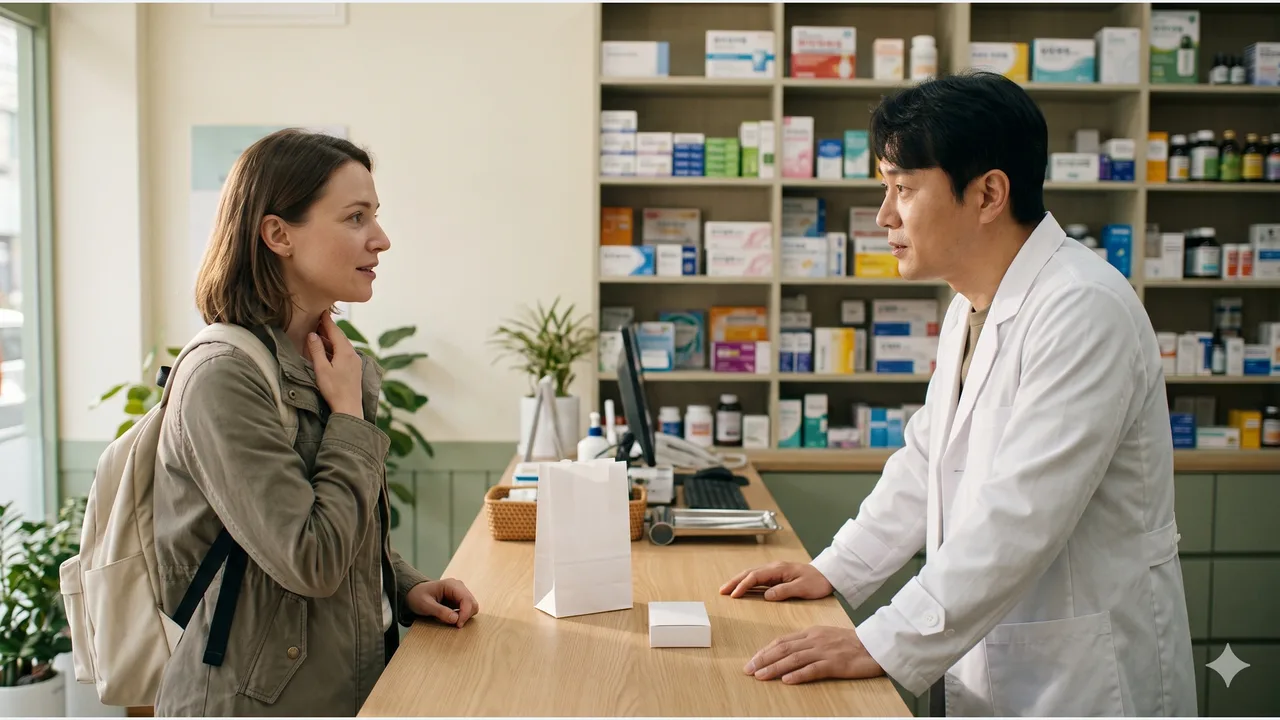
How do you say where it hurts at a pharmacy?
The easiest pattern is "body part + i/ga + apayo." Just swap the body part, such as throat, head or stomach. For symptoms that are not a place, such as a fever or a cough, use "nayo" instead. The table below collects practice sentences you can read out at the pharmacy counter.
| Situation | Korean phrase | Reading aid in romanization | English meaning |
|---|---|---|---|
| Your throat hurts | 목이 아파요 | Mogi apayo | My throat hurts |
| Your head hurts | 머리가 아파요 | Meoriga apayo | I have a headache |
| Your stomach hurts | 배가 아파요 | Baega apayo | My stomach hurts |
| You have a fever | 열이 나요 | Yeori nayo | I have a fever |
| You have a cough | 기침이 나요 | Gichimi nayo | I have a cough |
| You have a runny nose | 콧물이 나요 | Konmuri nayo | I have a runny nose |
| You hand over a prescription | 처방전 있어요 | Cheobangjeon isseoyo | I have a prescription |
"콧물이" is not read letter by letter; it sounds closer to [konmuri], which is why the romanization is Konmuri. If you cannot think of the body part, point to the spot and say "yeogiga apayo" (it hurts here).
How do you add when and how it started hurting?
Pharmacists often ask when a symptom started. Put "buteo" (since) after a time word, as in "eojebuteo apasseoyo" (it has hurt since yesterday), to give the starting point. Change only the first part to say "since this morning" (oneul achimbuteo) or "since three days ago" (saheul jeonbuteo).
To describe how strong it is, use "jogeum" (a little) or "mani" (a lot). "Mogi jogeum apayo" and "mogi mani apayo" name the same body part but tell the pharmacist something different about it. For a cough that gets worse at night, add "bame deo simhaeyo" (it is worse at night).
Short, separate sentences are easier to follow than one long one. Saying "My throat hurts. Since yesterday. No fever." as three sentences lets the pharmacist check each point and ask the next question.
What should you tell the pharmacist first?
Write the following Hangul sentences in a phone note in this order, and you can simply show the screen at the counter.
- Write where it hurts and your symptoms. Example: 목이 아파요, 기침이 나요.
- Write when it started. Example: 어제부터 아팠어요.
- If you have an allergy, write "allereugiga isseoyo" (I have an allergy) together with the name of the medicine or food that causes it.
- If you are taking other medicine, write "jigeum meongneun yagi isseoyo" (I am taking medicine now) and show the package or a photo of it.
- If you are pregnant, write "imsin jungieyo" (I am pregnant).
Medicine you take at home may go by a different name in Korea. A photo of the package showing the ingredient names, or of your prescription record, makes it easier for the pharmacist to check.
What should you ask after receiving your medicine?
When you receive medicine, ask the pharmacist directly how to take it. To ask how often, say "harue myeot beon meogeoyo?" (how many times a day do I take it?). To ask about meals, say "sikue meogeoyo?" (do I take it after meals?). If you are worried about driving or your plans, you can ask "meogeumyeon jollyeoyo?" (will it make me drowsy?).
If you missed the answer, ask "dasi malhae juseyo" (please say that again) or "yeogie sseo juseyo" (please write it here). If you were given instructions on the medicine bag or box, read them again with a translation app when you get back to your accommodation.
Where can you find a pharmacy open at night or on a holiday?
The Korean Pharmaceutical Association's holiday pharmacy site lets you search by pharmacy name, road name or neighborhood (dong) name, and on a map. It also has a search by province and district and a list of public late-night pharmacies. The same page lists 129, the health and welfare counseling number.
The National Emergency Medical Center's E-Gen has a nearby hospital and pharmacy finder and an emergency room finder, with an ENG menu at the top of the page. The menus on both sites are as of October 19, 2026. Opening hours can change, so before heading to a pharmacy you found, call and ask "jigeum mun yeoreosseoyo?" (are you open now?).
When should you go to a hospital or call 119 instead of a pharmacy?
Examinations and diagnoses happen at a hospital. If your symptoms do not improve after a few days or your fever keeps rising, see a doctor rather than moving from pharmacy to pharmacy. You can also ask the pharmacist "byeongwone gaya haeyo?" (should I go to a hospital?).
If it is an emergency, such as difficulty breathing, severe chest pain or fading consciousness, do not look for a pharmacy; call 119 right away. You can find the nearest emergency room with E-Gen's emergency room finder.
Frequently Asked Questions
What if the pharmacist cannot understand my pronunciation?
Write the Hangul sentence in a phone note and show the screen. Point to where it hurts and say 'yeogiga apayo' (it hurts here) to get the meaning across. If the pharmacist asks again, read the sentence from the table once more, slowly.
Can I ask questions in English at a pharmacy?
Whether English is available depends on the pharmacy. Try English first, and switch to your Hangul note if the conversation gets difficult. Even a note with just your symptoms, when they started and any allergies lets the pharmacist continue with the right questions.
Where can I find a pharmacy open at night or on a public holiday?
The Korean Pharmaceutical Association's holiday pharmacy site lets you search by neighborhood name or on a map, and it also lists public late-night pharmacies. The hospital and pharmacy finder on the National Emergency Medical Center's E-Gen does the same job. Opening hours can change, so call the pharmacy before you go.
Sources & Verification Date
- Korean Pharmaceutical Association holiday pharmacy finder · Verified
- National Emergency Medical Center E-Gen emergency room, hospital and pharmacy finder · Verified
All materials have been verified from official announcements and may have changed since verification.