Check How to Order at a Korean Restaurant and the Phrases You Need
This page contains Coupang Partners affiliate links; the operator may earn a commission.
Key Takeaway
The trick to ordering smoothly at a Korean restaurant is a simple formula: use the table bell or call "Jeogiyo" to the staff, then add "juseyo" after the name of the dish you want.
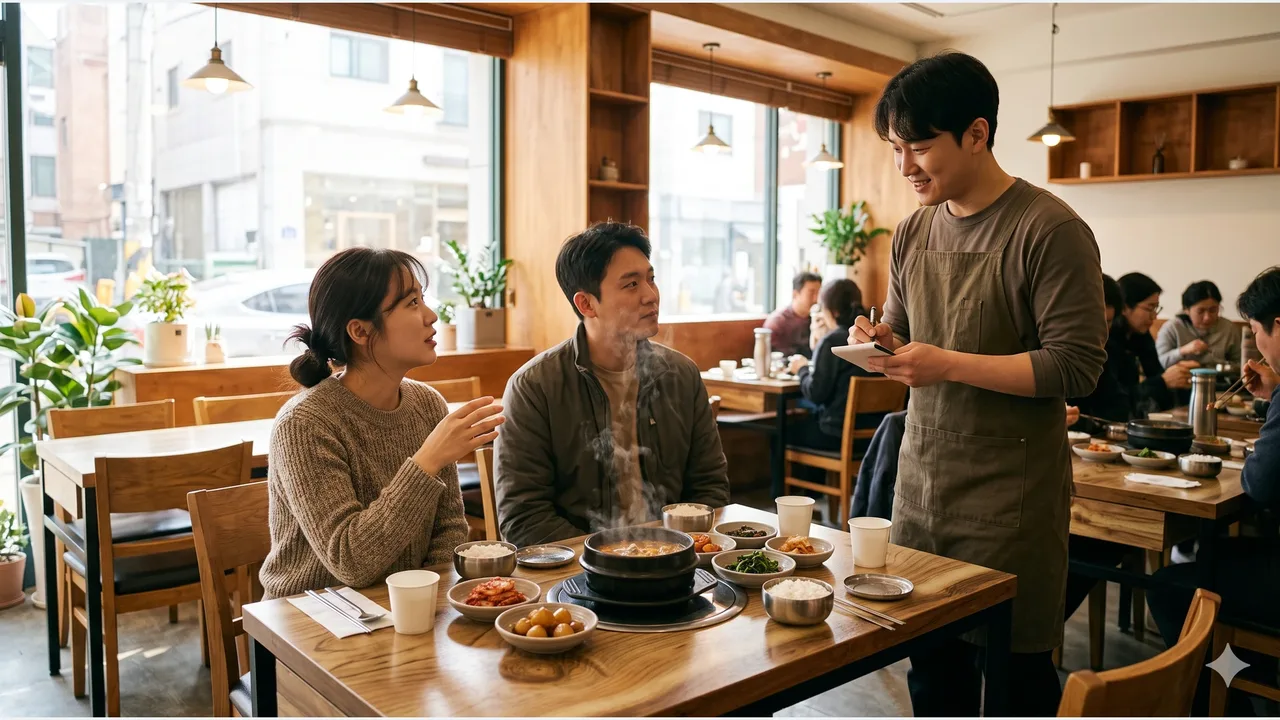
Korea's dining-out culture is faster, friendlier, and more convenient than almost anywhere else. Even if it is your first time in a restaurant, learning a few basic words lets you handle everything from water and side dish refills to paying the bill, without panic, like a local.
How does ordering work when you walk into a Korean restaurant?
When you walk in, the staff check how many people you have and show you to a table. Once you sit down, they bring cold water, cups, and wet wipes as standard, and the spoons, chopsticks, and napkins are often tucked in a drawer at the side of the table.
When you have decided from the menu, press the call bell (a "ding-dong" bell) at the corner of the table. Where there is no bell, lightly raise your hand when you catch someone's eye and say "Jeogiyo", and a staff member will come right over to take your order.
| Step at the restaurant | Recommended action | Key phrase |
|---|---|---|
| Step 1: Entering | Show the number of people with your fingers or numbers | Du myeong-ieyo (Two people) |
| Step 2: Sitting | Take the spoons and napkins out of the table drawer | Mul juseyo (Water, please) |
| Step 3: Ordering | Press the call bell or raise your hand | Igeo hana juseyo (One of this, please) |
| Step 4: During the meal | Ask for more side dishes or water | Banchan deo juseyo (More side dishes, please) |
| Step 5: Paying | Take the order slip to the counter | Gyesanhae juseyo (Check, please) |
What is the best way to ask for side dish refills and water?
One of the charms of Korean restaurants is that generous side dishes come free. If a side dish runs out during the meal, point at the bowl and say "Igeot jom deo juseyo" (a little more of this, please), and they will refill it generously.
Recently, many restaurants also have a self-service bar on one side of the store. Where there is one, it is good etiquette to take only as much as you will eat.
What dining etiquette should foreigners know?
In traditional Korean table manners, you do not pick up the rice bowl or soup bowl to eat from it. You leave it on the table and scoop with a spoon. If you also serve stews and soups onto your own small plate, a thoughtful habit, you will win the goodwill of the Korean friends you are eating with.
Key Korean Words and Sentences
Listen to the key words and practical phrases from this article and repeat them. Press the audio button next to each sentence to hear it spoken in a native Korean voice and intonation.
1. Essential Vocabulary
- Sikdang: Restaurant / a place that sells meals
- Menupan: Menu / a list of food to order
- Mul: Water / water for drinking
- Banchan: Side dishes / food served as standard
- Gyesanseo: Bill, Check / a slip listing what was ordered
2. Practical Sentences
| Pronunciation (Romanization) | Meaning in English | Audio |
|---|---|---|
| Jeogiyo, jumunhalgeyo | Excuse me, we are ready to order | <button type="button" class="tts-btn" data-tts="저기요, 주문할게요">🔊 Listen</button> |
| Igeo hana juseyo | Please give me one of this | <button type="button" class="tts-btn" data-tts="이거 하나 주세요">🔊 Listen</button> |
| Banchan jom deo juseyo | Could we have more side dishes, please? | <button type="button" class="tts-btn" data-tts="반찬 좀 더 주세요">🔊 Listen</button> |
| Gyesanhae juseyo | Check, please / I would like to pay | <button type="button" class="tts-btn" data-tts="계산해 주세요">🔊 Listen</button> |
3. Recommended Video Guide
These are useful videos that help with using Korean restaurants and practicing pronunciation. If you also watch the food-ordering episodes on the official channels of the National Institute of Korean Language and the Korea Tourism Organization (VisitKorea), you can pick up the intonation and gestures vividly.
Frequently Asked Questions
Do I have to pay extra when I want more side dishes at a Korean restaurant?
At most regular Korean restaurants, refills of basic side dishes (banchan) such as kimchi and seasoned vegetables are free. If you politely say "Banchan jom deo juseyo" (more side dishes, please), they will gladly refill them.
What is the most natural way to call a staff member?
If there is a call bell on the table, pressing it is best. If there isn't, lightly raise your hand and say "Jeogiyo" (excuse me) or "Sajangnim" (boss), which is polite and natural.
Do I pay at the table or at the entrance when leaving?
At most restaurants other than upscale ones, you take your bill (order slip) to the counter near the exit after the meal and pay there.
Sources & Verification Date
- National Institute of Korean Language, Basic Korean Dictionary: food and dining vocabulary guide · Verified
- Korea Tourism Organization, Korean food culture and restaurant guide for foreigners · Verified
All materials have been verified from official announcements and may have changed since verification.