Ask for the Meter and a Receipt in Korean the Next Time You Take a Taxi
Key Takeaway
In a Seoul taxi, show your destination and say "Miteogi kyeo juseyo" (please turn on the meter). When you get out, add "Kadeuro gyesanhalgeyo" and "Yeongsujeung juseyo".
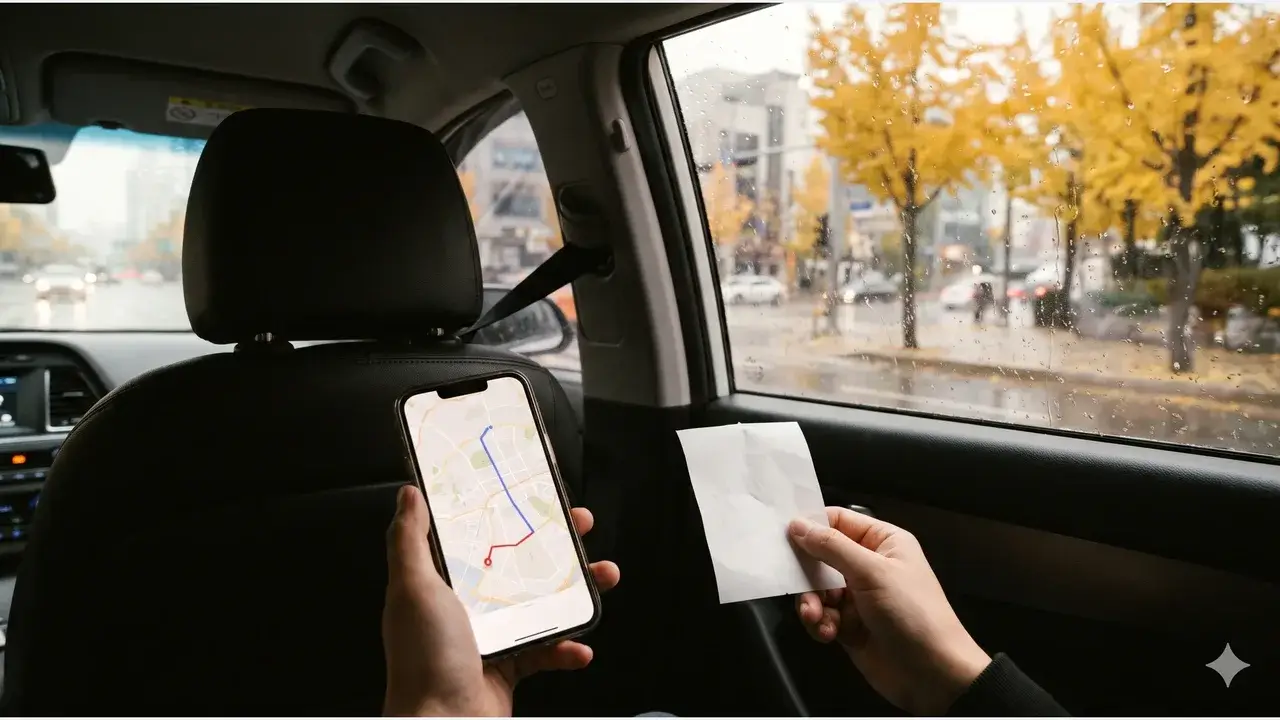
What should you prepare before getting in a taxi?
Open a map app screen that shows the Korean name and address of your destination. Write the same address in your phone's notes so you can show it even if the screen turns off. If many places have similar names, add the nearest subway station too.
If you use a hailing app, choose from the apps Seoul has named. The city lists K.ride and TABA as apps for foreign passengers, and Tada and Ondo as apps used by both residents and foreigners. These apps are being changed to show the running fare and the expressway toll separately on the booking screen. Check that your app shows two separate amounts before you book. Checked on October 23, 2026, on Seoul's official notice.
How do you say your destination and the meter when you get in?
The table below has practice phrases for boarding. Swap in the place name and address you actually need. The romanization is only a reading aid, so save the Korean sentences too.
| Situation | Korean phrase | Romanization (reading aid) | English meaning |
|---|---|---|---|
| Showing a screen and giving your destination | 이 주소로 가 주세요 | I juso-ro ga juseyo | Please go to this address |
| Asking to go by meter | 미터기 켜 주세요 | Miteogi kyeo juseyo | Please turn on the meter |
| Asking about the route | 통행료 있는 길로 가도 돼요? | Tonghaengnyo inneun gillo gado dwaeyo? | Is it okay to take a toll road? |
| Telling the driver where to stop | 여기서 내려 주세요 | Yeogiseo naeryeo juseyo | Please let me out here |
| Paying by card | 카드로 계산할게요 | Kadeuro gyesanhalgeyo | I will pay by card |
| Asking for a receipt | 영수증 주세요 | Yeongsujeung juseyo | Please give me a receipt |
"Juseyo" is a polite request, so you can attach it to a destination, a receipt or a stop. Only the verb before it changes, such as "ga", "kyeo" or "naeryeo". Raising your voice at the end, as in "dwaeyo?", turns it into a question asking permission.
How do you check the fare and tolls?
Seoul's taxi fare page says taxis must charge by the meter unless Seoul has approved a separate fare system. The final fare is rounded to the nearest 10 won. The page was last modified on October 14, 2026, and checked on October 23 of the same year.
A fare can include a surcharge or a toll in these cases.
- A late-night surcharge applies from 10 p.m. to 4 a.m. The rate varies by hour.
- A surcharge applies on trips that leave the Seoul city boundary.
- When a passenger asks for a toll road or paid facility, the toll is paid separately at cost. Fixed airport zone fares are described as including tolls.
- International taxis, also called foreigner tourist taxis, may add a foreign passenger surcharge to the metered fare.
English labels are also being standardized. Seoul says it is unifying the different wording used across taxi platforms as "Meter Fare" and "Toll fee". When you see these two words on an English fare screen, read the first as the metered fare and the second as the toll.
How do you ask for a receipt and card payment when you get out?
Seoul's receipt guidance says a driver must issue a receipt on request and must accept a card payment request. A complaint is not upheld just because the driver did not mention it first, so ask when you pay or before you get out. If you plan to pay by card, say "Kadeuro gyesanhalgeyo" before you pay.
Since December 2025, Seoul taxi receipts show the final fare and the boarding and drop-off times in English as well. They also show whether a late-night or out-of-city surcharge applied. A notice at the bottom of the receipt points to the 120 Dasan Call Center for taxi complaints. Photograph the receipt and keep it until any inquiry is finished.
- Say "Yeongsujeung juseyo" before you get out.
- Read the final fare and the boarding and drop-off times on the receipt.
- If a surcharge is marked, think back to whether it was after 10 p.m. or a trip outside the city.
- Take a photo of the receipt so the vehicle information is visible.
What should you do if the fare feels wrong?
For Seoul taxis, the 120 Dasan Call Center is the contact point for fare questions and complaints. Seoul's unfair fare collection page gives these examples of unfair charges: collecting more than the meter shows, taking a long detour without the passenger's consent, and adding a surcharge that does not apply.
Seoul also runs a complaint system in which passengers scan a QR code inside the taxi and answer a survey about their ride. The city says it has attached complaint-guide stickers inside about 71,000 Seoul taxis. When preparing a report, organize the date and time of the ride, the pickup and drop-off points, and a photo of the receipt.
What Seoul handles is administrative penalties such as fines. It does not process refunds, so ask the taxi transport association or the operating company about refunds separately. If a taxi ride leaves you lost or needing an interpreter, save how to ask the 1330 travel helpline for your location and interpretation as well.
Frequently Asked Questions
What if it is hard to say my destination in Korean?
Show the driver a map app screen where the Korean name and address of your destination are visible. Saying "I juso-ro ga juseyo" (please go to this address) is enough. If several places share a name, show the nearest station name too.
Do I have to ask for the receipt as I get out?
Seoul's guidance says a driver must give a receipt when the passenger asks, and that a complaint is hard to uphold just because the driver did not offer one first. Say "Yeongsujeung juseyo" when you pay or before you get out.
Where do I ask if the fare feels wrong?
For Seoul taxis, contact the 120 Dasan Call Center. The receipt shows vehicle information, so photograph it and keep it. Seoul handles administrative penalties such as fines, and says to ask the taxi association or the operating company separately about refunds.
Sources & Verification Date
- Seoul Metropolitan Government notice: English on taxi receipts and better services for foreign passengers · Verified
- Seoul Metropolitan Government transport information: Seoul taxi fares · Verified
- Seoul Metropolitan Government transport information: failure to issue a receipt and refusal of card payment · Verified
- Seoul Metropolitan Government transport information: unfair fare collection · Verified
All materials have been verified from official announcements and may have changed since verification.