Learn the Etiquette for Volume-Rate Garbage Bags and Recycling Separation in Korea
Key Takeaway
When staying at a guesthouse, studio apartment, or residential flat in Korea, you need to follow strict separation rules for general waste, food waste, and recyclables.
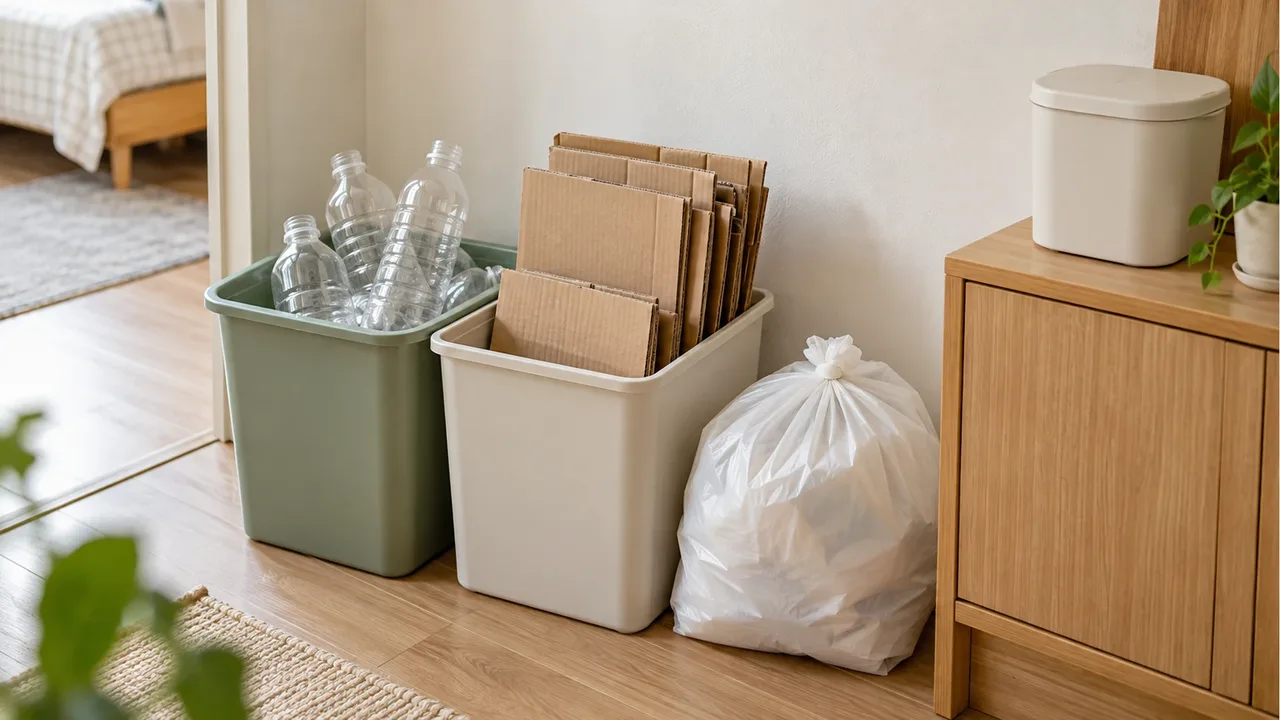
Where and how do you buy volume-rate garbage bags?
In Korea, disposing of general waste in ordinary plastic shopping bags is strictly prohibited and can lead to a fine. You must use official local government bags called "jongnyangje bongtu" (volume-based rate garbage bags) and tie them securely before taking them out.
You can buy these bags at checkout counters in convenience stores (such as CU, GS25, or 7-Eleven), local supermarkets, or large discount marts near your accommodation. Because stores usually store them behind the cashier desk rather than on regular shelves, you need to ask the cashier directly.
Garbage bags are managed independently by each autonomous district (such as Mapo-gu, Gangnam-gu, or Jongno-gu). A bag purchased in Mapo-gu cannot be used in Gangnam-gu, so make sure to buy your bags in the specific district where you are staying. If you are travelling alone or staying for a short time, 5-liter or 10-liter bags are ideal for keeping your room clean and odor-free.
What Korean phrases do you use at the convenience store?
Here are practical Korean phrases to use when asking the cashier for waste bags or checking waste separation rules. You can substitute the bag volume (5L, 10L, 20L) and quantity according to your needs.
| Situation | Korean phrase | Romanization (reading aid) | English meaning |
|---|---|---|---|
| Buying general waste bags | 종량제 봉투 10리터 한 장 주세요 | Jongnyangje bongtu sip-riteo han jang juseyo | Please give me one 10-liter volume-rate garbage bag |
| Asking for food waste bags | 음식물 쓰레기봉투도 있나요? | Eumsikmul sseuregibongtudo innayo? | Do you also have food waste bags? |
| Asking where to put recyclables | 분리수거 어디에 버리면 돼요? | Bunrisugeo eodie beorimyeon dwaeyo? | Where should I throw the recyclables? |
| Asking if an item is general waste | 이거 일반 쓰레기 맞아요? | Igeo ilban sseuregi majayo? | Is this general waste? |
| Checking the fill line | 묶는 선까지 채우면 돼요? | Mungneun seonkkaji chaeumyeon dwaeyo? | Should I fill it up to the tie line? |
Simply attach the desired volume in liters and the count before "juseyo" (please give me). If you only need a single bag, say "han jang" (one sheet), and if you want a bundle of ten, say "han mukkeum" (one bundle).
How do you distinguish food waste from general waste?
According to Seoul's household waste guide, the core question when sorting food waste is whether it can be processed into animal feed or compost. Even if an item comes from food, hard or non-nutritive remnants are considered general waste.
Common kitchen remnants that look like food waste but must go into general garbage bags include:
- Beef, pork, and chicken bones, as well as fish bones
- Shellfish shells (clams, oysters, abalone) and crustacean shells (crabs, lobsters)
- Eggshells (chicken, duck, or quail eggs)
- Hard nut shells (walnuts, chestnuts, peanuts) and hard stone fruit pits (peaches, apricots, persimmons)
- Dry skins of onions, garlic, ginger, and corn, as well as green onion roots
- Tea leaves, coffee grounds, and traditional herbal medicine dregs
Soft fruit peels, such as watermelon, banana, and apple peels, should be thrown into food waste. Cut large vegetable or peel remnants into smaller pieces and squeeze out excess moisture before putting them into food waste bags or dedicated food waste bins to prevent foul odors.
In what order should you separate recyclables?
The Ministry of Environment's recycling guideline highlights four fundamental principles: empty, rinse, separate, and do not mix.
- Empty contents: Thoroughly empty all drinks, liquids, and leftover food remnants.
- Rinse foreign matter: Wash the inside of containers with water. Takeout containers stained heavily with oil or red chili sauce cannot be recycled and must go into general waste bags.
- Separate labels: Remove vinyl adhesive labels from clear plastic bottles and dispose of them with soft vinyl. Flatten the bottle body and screw the cap back on before disposal.
- Sort by category: Flatten cardboard boxes after stripping off all packing tape and shipping invoice stickers. Glass bottles, aluminium cans, rigid plastics, and vinyl wrappers should each be placed into their designated recycling bins.
Since 2020, South Korea has enforced mandatory separate collection for clear, colorless PET bottles (such as bottled water and soda containers). If a dedicated clear PET bin is present, always place transparent bottles there separately from colored plastics.
How do you observe the time and location for taking out trash?
Apartment complexes and modern studio buildings often have designated recycling depots in the basement or courtyard that can be used at any time. However, ordinary residential areas, traditional villas, and small studio houses rely on curbside door-to-door collection, where waste must be placed outside your entrance only on scheduled days and hours.
In Seoul districts, the standard rule is to put waste out after sunset, usually between 8:00 PM and 5:00 AM the following morning. Leaving trash outside during the daytime causes bad odors and attracts street animals, which can result in a fine.
Furthermore, waste collection trucks do not operate over weekends (Saturday) in most districts, so trash should not be left on the street on Friday evening or Saturday daytime. Ask your host or building manager beforehand by asking "Sseuregi beorineun yoiri eonjeyeyo?" (Which days is trash collected?). If you need directions or emergency assistance, you can also check our guide on how to ask for location help and interpretation on the 1330 travel helpline.
Frequently Asked Questions
Are chicken bones and shellfish shells food waste?
Hard bones and shells that cannot be consumed by animals are classified as general waste. Beef, pork, and chicken bones, shellfish and crab shells, eggshells, and hard fruit pits must all go into general volume-rate garbage bags.
Can I use garbage bags bought in a different district?
Waste collection contracts are made by local autonomous district (gu), so bags can only be used within the district where they were issued. Always purchase bags at a convenience store or market in the neighbourhood of your accommodation.
Can plastic delivery containers with sauce stains be recycled?
If red food sauce or oil can be completely rinsed away with water, they can be recycled as plastic. However, if stains or grease remain deeply embedded, they cannot be recycled and must be thrown into general volume-rate garbage bags.
Sources & Verification Date
- Seoul Metropolitan Government household waste separation guide · Verified
- Ministry of Environment recycling guideline for everyday life · Verified
All materials have been verified from official announcements and may have changed since verification.